Britten
Native SonBritten is the police investigator who questions Bigger Thomas during the search for Mary Dalton and helps direct suspicion toward Jan Erlone. He enters the inquiry treating Bigger as a suspect whose answers must be controlled, but his judgments shift with the changing kidnapping story: he first entertains Communist involvement, then repeatedly favors Jan as the likely author of the supposed scheme. His conduct makes him an active force in the investigation, while his later testimony shows that suspicion and certainty do not amount to a clear account of Bigger’s concealed responsibility.
Identity and Introduction
Britten first appears in the basement of the Dalton family residence beside Mr. Dalton. In the dim light, Bigger initially reads the men as a threatening group; when Britten turns on the light, his impersonal manner heightens Bigger’s alarm. Bigger notices the badge on Britten’s chest and recognizes that he is a police officer. The encounter is therefore framed from the start through the suspect’s fearful perception: Britten’s official authority becomes a sign of danger before he has explained what he wants.
Britten’s manner does not settle into one consistent register. He can question Bigger in a conversational tone, telling him there is time, while also controlling where he stands and what he is allowed to say. This alternation matters to the investigation’s atmosphere. Apparent patience does not remove the pressure; Britten remains the officer setting the terms, and Bigger understands that any answer may produce further scrutiny.
Interrogation and Shifting Suspicions
Britten’s questioning becomes openly coercive when he suspects that Bigger may be connected to the Communist Party. Bigger has not anticipated that line of inquiry. As he denies knowing Communist associates, Britten follows him until he is backed against a wall, grabs him by the collar, and forces his head against it. He accuses Bigger of being a Communist and demands information about Mary and Jan. The episode shows Britten converting political suspicion into physical intimidation rather than establishing it through evidence.
The investigation also uses Bigger to place Jan at the scene. Britten asks whether Jan is the man Mary brought to the house the previous night, and Bigger confirms that he is. Bigger knows the answer will hurt Jan, whose incredulous reaction makes Bigger feel guilty, but the exchange helps Britten build a line of inquiry around him. Britten does not merely receive information: through his questions, he organizes the available facts into a developing suspicion of Jan.
That suspicion becomes more explicit after Mary’s disappearance. Britten asks Bigger directly whether he thinks Jan is involved. Bigger avoids a definite accusation, saying he does not know, because he fears that a direct charge would invite closer questioning of himself. He intends instead to hint toward Jan. Britten’s question thus gives Bigger an opening to redirect attention without openly committing to a story, and the investigation continues to follow the direction of that suggestion.
Britten’s assumptions are also shaped by racialized ideas about the case. He asks whether Jan said anything to Bigger about white women, a question that makes Bigger tense with alarm. The inquiry is not confined to reconstructing movements or testing the kidnapping claim: it also probes the charged possibility of relations between a Black man and white women. Britten’s questions bring that social fear into the police investigation and sharpen Bigger’s sense that ordinary answers can be made dangerous.
The Kidnapping Inquiry
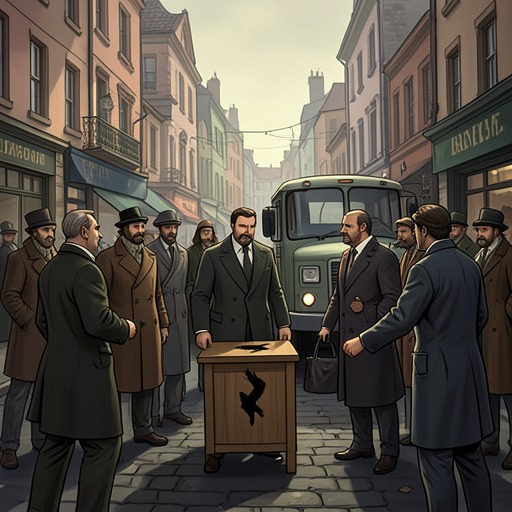
As the supposed kidnapping develops, Britten manages access to Mr. Dalton and the information reaching the investigators. When men arrive seeking to speak with Mr. Dalton, Britten tells them that the old man cannot see them until Tuesday. Bigger takes this as a sign that Mr. Dalton intends to pay the demanded money rather than call in the police. Britten’s announcement therefore has significance beyond scheduling: it confirms to Bigger that the deception may still be working and that the family’s response is being shaped by the ransom demand.
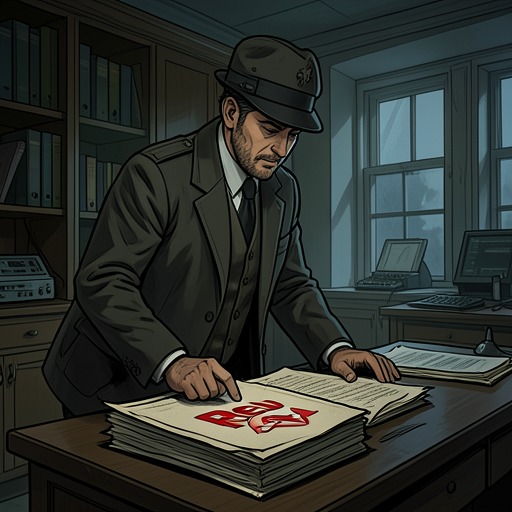
The letter is presented as having arrived that night, left under the door rather than delivered through the mail. Britten urges the other investigators to give Mr. Dalton time because he is trying to get his daughter back alive. He asks them to wait rather than press for more details, even though the available evidence is thin: the note is signed Red and bears a hammer-and-sickle emblem, and Jan is to be released. In this stage of the inquiry, Britten protects the father’s effort to recover Mary while allowing a politically suggestive emblem and suspicion of Jan to carry more weight than they can independently establish.
His confidence in Jan becomes blunt when he says he would wager heavily that the kidnapping was Jan’s clever idea. Bigger, exhausted and barely able to keep alert, says nothing. Britten’s certainty contrasts with the uncertainty of the evidence described by the other men, who point out that a letter, Jan’s release, a signature, and an emblem do not make a coherent case. The contrast reveals an investigator who can acknowledge the need to wait while still advancing a preferred explanation as though it were nearly settled.
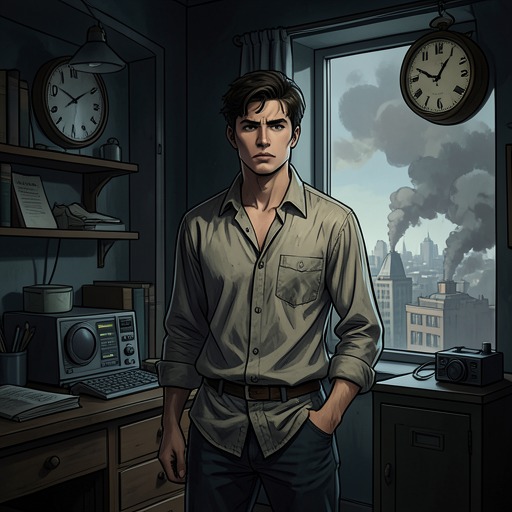
Britten also remains attentive to the furnace while Bigger is questioned in the basement. When smoke fills the room and the fire cannot draw enough air, Britten calls out that the fire needs air. Bigger is left trying to respond while struggling to see and breathe through the smoke. The incident places Britten physically near the process that is destroying evidence, but the scene does not show him recognizing what the furnace contains. His attention remains on the immediate malfunction, and the concealed cause of it remains beyond his knowledge at that point.
Testimony and Narrative Significance
At the inquest, Britten gives an account of his suspicions. He says that he had suspected Bigger knew something about Mary’s disappearance, and describes Bigger as sane. His testimony distinguishes suspicion from proof: Britten had regarded Bigger as potentially informed, yet the account does not establish that he had uncovered Bigger’s actions. The contrast between his early forceful interrogation and his later statement also underlines the limits of his investigative certainty.
Britten’s role is consequently defined less by a final solution than by the paths of attention he creates. He presses Bigger with physical force, entertains a Communist explanation, directs questions toward Jan, and speaks with confidence about Jan’s supposed plan, even as the case’s clues remain incomplete. His presence demonstrates how an investigation can gather statements while being steered by assumptions about political affiliation and interracial relations. For Bigger, Britten is at once the officer who threatens exposure and an authority whose changing focus offers opportunities to divert suspicion; for the reader, he embodies the unstable boundary between inquiry and presumption.